Fenwick Tree
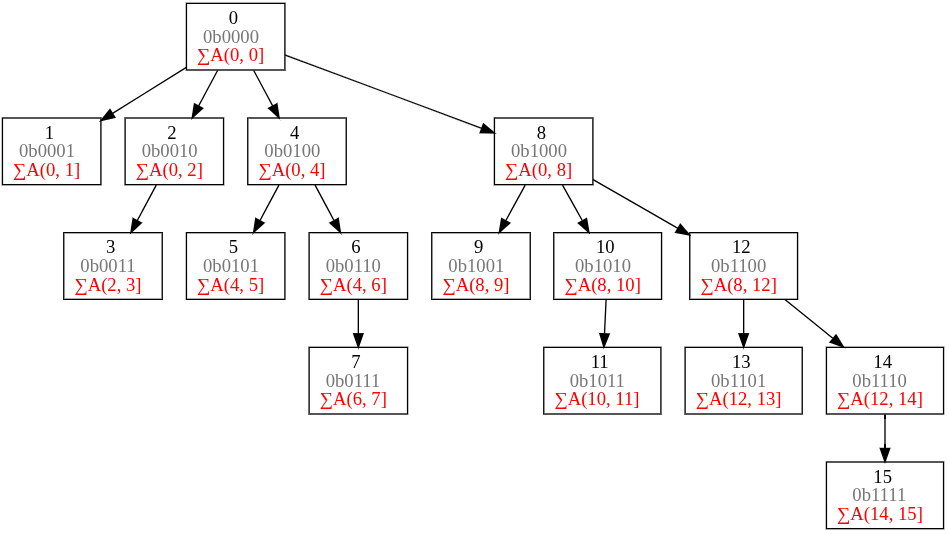
LBS (Least Significant Bit) two core functions
LBS it is the last set bit of a number.
DEC    BIN     LBS
0      0000     -
1      0001    0001
2      0010    0010
3      0011    0001
4      0100    0100
5      0101    0001
6      0110    0010
7      0111    0001
8      1000    1000
9      1001    0001
10     1010    0010
11     1011    0001
12     1100    0100
13     1101    0001
14     1110    0010
15     1111    0001
It can be calculated using the expression:
LBS(i) = i & -i
For example:
LBS(6) = 6 & -6 = 2  (binary `0110` & `1010` = `0010`)
LBS(8) = 8 & -8 = 8  (binary `1000` & `1000` = `1000`)
- To convert positive number \(i\) to its negative counterpart:
- Flip all the bits of \(i\) (bitwise NOT operation).
- Add \(1\) to the result.
6:  0110
-6: 1001+1 = 1010
1. Defining the Range of Sums (Responsibility)
Each node at index \(i\) is responsible for storing the sum of an interval of length equal to its lowest set bit (\(\text{LSB}(i)\)).
Specifically, the node at index \(i\) covers the range:
\(\left[i - \text{LSB}(i) + 1, \; i\right]\)
- Index \(6\) (binary
0110): \(\text{LSB}(6) = 2\) (0010). It stores the sum of \(2\) elements ending at index \(6\)—meaning elements in the range \([5, 6]\). - Index \(8\) (binary
1000): \(\text{LSB}(8) = 8\) (1000). It stores the sum of \(8\) elements ending at index \(8\)—meaning elements in the range \([1, 8]\).
                                  _________
                                  ______
                            ______
                       ______________
                       _________
                       _____
                 ______
           _________
           ______
     _______
   _______________________
   ____________
   ______
   ___

 +--+--+--+--+--+--+--+--+--+--+--+--+--+--+--+
 0  1  2  3  4  5  6  7  8  9 10 11 12 13 14 15
2. Navigating the Tree (Updates and Queries)
The LSB acts as a step vector to move between parent and child relationships depending on whether you are updating a value or querying a prefix sum:
Updating a Value
Parent Node is calculated by expression:
parent(i) = i + (i & -i)
For example, to find the parent of index \(6\):
parent(6) = 6 + (6 & -6) = 6 + 2 = 8
Indexes of parent nodes create a tree:
nums: [...]
indexes of parent nodes: [1, 2, 3, 4, 5, 6, 7, 8, 9, 10, 11, 12, 13, 14, 15, 16]
                 16
          ┌──────┼──────┐
          8      12     14
       ┌──┼──┐  ┌┴─┐   ┌┴─┐
       4  6  7  10 11  13 15
      ┌┴┐ └┐
      2 3  5
      │
      1
Note: for array with 15 elements (1-indexed), the tree will not have root at index 16, as the highest index is 15.
Querying a Prefix Sum
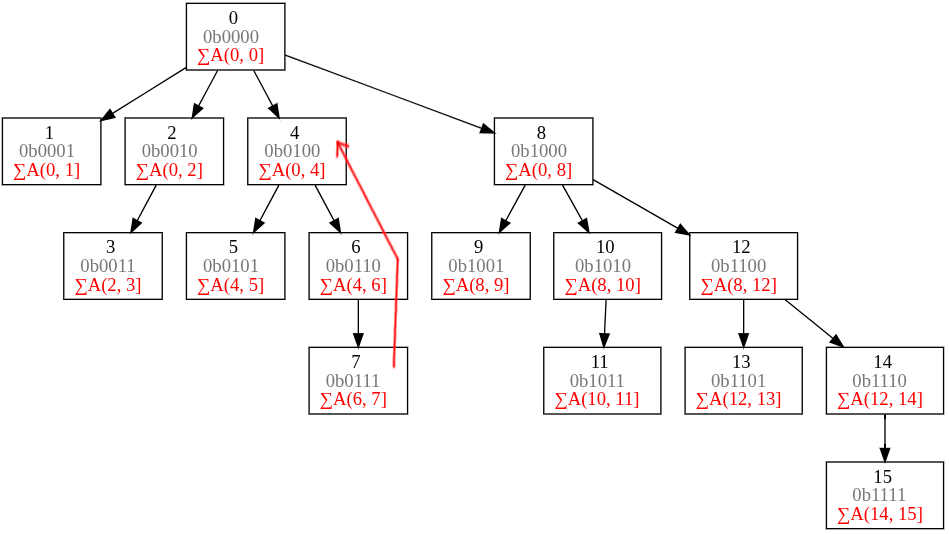
Sum of 7 = nums[7] + nums[6] + nums[4]
C# Implementation of Fenwick Tree
var numArray = new NumArray([1, 2, 3, 4, 5]);

Console.WriteLine("Tree before update: " + string.Join(", ", numArray.Tree));

numArray.Update(2, 10);
var sum = numArray.SumRange(1, 3);

Console.WriteLine("Sum after update: " + sum);
Console.WriteLine("Tree after update: " + string.Join(", ", numArray.Tree));


// Tree before update: 0, 1, 3, 3, 10, 5
// Sum after update: 16
// Tree after update: 0, 1, 3, 10, 17, 5

public class NumArray
{
    int[] nums;
    int[] tree;
    public NumArray(int[] nums)
    {
        this.nums = nums;
        this.tree = new int[nums.Length + 1];
        for (int i = 1; i <= nums.Length; i++)
        {
            this.tree[i] = this.nums[i - 1];
        }

        for (int i = 1; i <= nums.Length; i++)
        {
            var parent = i + (i & -i);
            if (parent < this.tree.Length)
            {
                this.tree[parent] += this.tree[i];
            }
        }
    }

    public int[] Tree => tree;

    public void Update(int index, int val)
    {
        var diff = val - this.nums[index];
        this.nums[index] = val;

        index++;

        // update all parents
        while (index < this.tree.Length)
        {
            this.tree[index] += diff;
            index += index & -index;
        }
    }

    public int SumRange(int left, int right)
    {
        right++;
        left++;
        return PrefixSum(right) - PrefixSum(left - 1);
    }

    private int PrefixSum(int index)
    {
        var sum = 0;

        while (index > 0)
        {
            sum += this.tree[index];
            index -= index & -index;
        }
        return sum;
    }
}
Fenwick Tree vs Segment Tree
| Feature | Fenwick Tree | Segment Tree |
|---|---|---|
| Build | O(n log n) | O(n) |
| Update | O(log n) | O(log n) |
| Query | O(log n) | O(log n) |
| Space | O(n) | O(4n) |
Fenwick Tree is generally more space-efficient than Segment Tree, but Segment Tree is more versatile and can handle a wider range of queries.