Memoization vs. Tabulation
Memoization and tabulation are two fundamental techniques in dynamic programming used to optimize overlapping subproblem computations by storing intermediate results. Memoization is a top-down approach where results are cached on demand as recursive functions execute, while tabulation is a bottom-up approach that iteratively populates a table of results.
Memoization
In memoization, we store the results of expensive function calls and reuse them when the same inputs recur. This technique eliminates redundant calculations and substantially improves the performance of recursive algorithms.
Tabulation
Tabulation involves solving subproblems iteratively and storing their results in a table (typically an array or matrix). This approach begins at the base cases and works upward to the target solution, ensuring each subproblem is evaluated exactly once.
The Graph Connection
Every dynamic programming problem relies on two core elements:
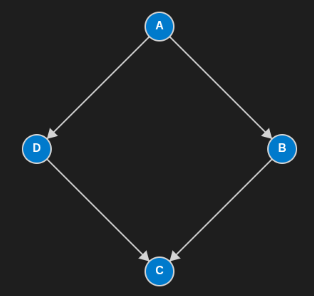
- States: Each unique subproblem acts as a vertex (node) in a dependency graph.
- Transitions: Directed edges represent state dependencies (how one subproblem relies on or transitions to another).
Because subproblems must be resolved prior to the states that depend on them, these dependencies form a Directed Acyclic Graph (DAG). Solving a dynamic programming problem is equivalent to finding a shortest path, longest path, or counting paths through this DAG via depth-first search (DFS) or topological sorting.
- Memoization uses
DFS with recursion, starting at the target node and diving down to base cases, caching results along the way. - Tabulation evaluates nodes in
topological order(often implemented using nested loops orBFS via Kahn's algorithm).
Example 1
Longest Common Subsequence (LCS)
An LCS (longest common subsequence) is the longest subsequence shared across a set of sequences.
LCS dynamic programming solutions can be viewed through graph theory as a Directed Acyclic Graph (DAG) of overlapping subproblems.
It can be computed efficiently using dynamic programming via memoization or tabulation.
An LCS is used to implement diff tools, compare file versions, and find similarities between sequences.
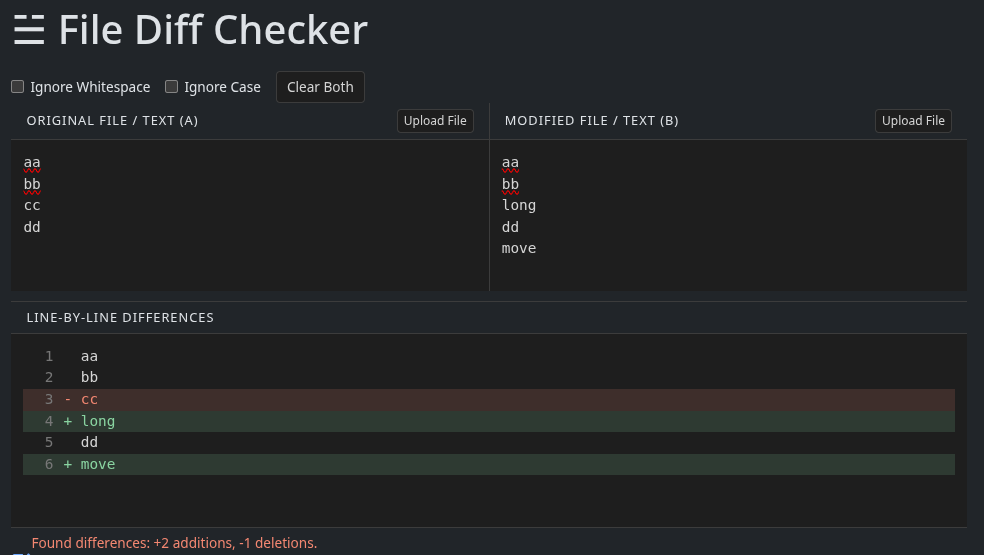
Longest Common Subsequence (LCS) - Problem Description
Given two strings
text1andtext2, return thelength of their longest common subsequence. If there is no common subsequence, return 0.
A subsequence of a string is a new string generated from the original string with some characters (can be none) deleted without changing the relative order of the remaining characters.
For example, "ace" is a subsequence of "abcde".
A common subsequence of two strings is a subsequence that is common to both strings.
Example 1:
Input: text1 = "abcde", text2 = "ace" Output: 3
Explanation: The longest common subsequence is "ace" and its length is 3.
Example 2:
Input: text1 = "abc", text2 = "abc" Output: 3 Explanation: The longest common subsequence is "abc" and its length is 3.
Example 3:
Input: text1 = "abc", text2 = "def" Output: 0 Explanation: There is no such common subsequence, so the result is 0.
Constraints:
1 <= text1.length, text2.length <= 1000 text1 and text2 consist of only lowercase English characters.
Graph Representation of LCS States
Two strings can be represented as a graph where:
- Nodes: Each node corresponds to a state \((i, j)\), representing the current positions in
text1andtext2. - Directed Edges: Transitions flow from state \((i, j)\) based on character matching:
- If \(A[i] == B[j]\): An edge leads from \((i, j)\) to \((i+1, j+1)\), representing a match.
- Otherwise: Two branching edges lead from \((i, j)\) to \((i+1, j)\) and \((i, j+1)\), representing deletions from either string.
Memoization Approach
It performs a lazy, demand-driven traversal with DFS. It only visits nodes and subproblems that are strictly reachable from the initial call.
public class Solution {
    public int LongestCommonSubsequence(string text1, string text2) {
        var memo = new int?[text1.Length, text2.Length];

        return DFS(text1, text2, 0, 0, memo);
    }

    public int DFS(string text1, string text2, int i, int j, int?[,] memo) {
        if (i >= text1.Length || j >= text2.Length) {
            return 0;
        }
        if (memo[i, j].HasValue) {
            return memo[i, j].Value;
        }

        int result;

        // Transitioning to the next state(node) based on character match or skip
        if (text1[i] == text2[j]) {
            // Branch: both are equal
            result = 1 + DFS(text1, text2, i + 1, j + 1, memo);
        } else {
            // Branch: skips one character from either string
            result = Math.Max(
                DFS(text1, text2, i + 1, j, memo),
                DFS(text1, text2, i, j + 1, memo)
            );
        }

        memo[i, j] = result;
        return result;
    }
}
Tabulation Approach
Tabulation approaches the graph iteratively, filling the grid from the base cases \((0, 0)\) up to \((rows, cols)\) in topological order. It evaluates every single node in the \(rows \times cols\) grid systematically, regardless of whether a specific subproblem is strictly necessary for the final path.
2D Tabulation Implementation
public class Solution
{
    public int LongestCommonSubsequence(string text1, string text2)
    {
        var rows = text1.Length;
        var cols = text2.Length;
        var table = new int[rows + 1, cols + 1];

        for (int i = 1; i <= rows; i++)
        {
            for (int j = 1; j <= cols; j++)
            {
                if (text1[i - 1] == text2[j - 1])
                {
                    // Branch: both are equal
                    table[i, j] = 1 + table[i - 1, j - 1];
                }
                else
                {
                    // Branch: skips one character from either string
                    table[i, j] = Math.Max(
                        table[i, j - 1],
                        table[i - 1, j]
                    );
                }
            }
        }

        return table[rows, cols];
    }
}
1D Tabulation Implementation
In the 2D version, computing table[i, j] relies on only three values:
- table[i - 1, j - 1] (The diagonal element: results without both characters)
- table[i - 1, j] (The top element: results from the previous row at the same column)
- table[i, j - 1] (The left element: results from the current row at the previous column)
Because row \(i\) never looks back at rows except the previous one, storing the entire 2D table wastes memory. A single 1D array of size \(cols + 1\) can represent the "previous row" and be updated in place for the "current row."
public class Solution
{
    public int LongestCommonSubsequence(string text1, string text2)
    {
        var rows = text1.Length;
        var cols = text2.Length;
        var table = new int[cols + 1];

        for (int i = 1; i <= rows; i++)
        {
            int previous = 0;
            for (int j = 1; j <= cols; j++)
            {
                var tmp = table[j];
                if (text1[i - 1] == text2[j - 1])
                {
                    // Branch: both are equal
                    table[j] = 1 + previous;
                }
                else
                {
                    // Branch: skips one character from either string
                    table[j] = Math.Max(table[j], table[j - 1]);
                }
                previous = tmp;
            }
        }

        return table[cols];
    }
}
- table[j] holds the value from the previous row (table[i - 1, j]). This replaces the need for the "top" value.
Example 2
The classic Grid Unique Paths problem is the perfect example of a simple 2D DP table. Imagine a 3x3 grid (9 cells total). A robot starts at the top-left corner (0,0) and wants to reach the bottom-right corner (2,2). The robot can only move Down or Right at any step. The goal is to find the total number of unique ways to reach the destination.
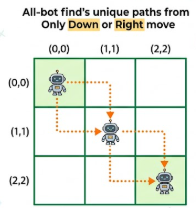
1. Defining the State and Cell Values
- The State (Indices): The row i and column j represent the robot's current position (i, j).
- The Cell Value (dp[i][j]): The number stored inside the cell is the total unique paths to reach that specific cell from the starting point.
2. The Base Cases
The robot starts at (0,0), which counts as 1 path to begin with. Because the robot can only move right or down, there is only 1 way to reach any cell in the very first row (by just walking straight right) and only 1 way to reach any cell in the first column (by just walking straight down).
3. The DP Table Layout and Transitions
To get to any inner cell, the robot must have come from either the cell directly above it or the cell directly to its left. Therefore, the transition formula is: \(\text{dp}[i][j] = \text{dp}[i-1][j] + \text{dp}[i][j-1]\) Here is how the 3x3 table is filled out step-by-step:
| Row / Col | Column 0 | Column 1 | Column 2 |
|---|---|---|---|
| Row 0 | 1 (Start) | 1 (Go Right) | 1 (Go Right) |
| Row 1 | 1 (Go Down) | 2 (1 from top + 1 from left) | 3 (1 from top + 2 from left) |
| Row 2 | 1 (Go Down) | 3 (2 from top + 1 from left) | 6 (3 from top + 3 from left) |
Summary of this 2D Table
- Indices [2][2] (The State): Represents the bottom-right corner.
- Value 6 (The Value): The final answer. There are exactly 6 unique ways for the robot to reach the destination.
C# Implementation
using System;

class Program
{
    static void Main()
    {
        int rows = 3;
        int cols = 3;

        int totalPaths = UniquePaths(rows, cols);

        Console.WriteLine($"Total unique paths to reach the bottom-right corner: {totalPaths}");
        // Total unique paths to reach the bottom-right corner: 6
    }

    static int UniquePaths(int m, int n)
    {
        // 1. Create the 2D DP Table.
        // The indices [i, j] represent the STATE (the current grid position).
        int[,] dp = new int[m, n];

        // 2. Initialize Base Cases (First Column)
        // There is only 1 way to reach any cell in the first column (by going straight down).
        for (int i = 0; i < m; i++)
        {
            dp[i, 0] = 1;
        }

        // 3. Initialize Base Cases (First Row)
        // There is only 1 way to reach any cell in the first row (by going straight right).
        for (int j = 0; j < n; j++)
        {
            dp[0, j] = 1;
        }

        // 4. Fill the rest of the DP table using the transition formula
        for (int i = 1; i < m; i++)
        {
            for (int j = 1; j < n; j++)
            {
                // The VALUE at this state is the sum of the values from the top and left states.
                dp[i, j] = dp[i - 1, j] + dp[i, j - 1];
            }
        }

        // 5. The final answer is stored at the destination state (bottom-right corner)
        return dp[m - 1, n - 1];
    }
}